
Clear, Matter, Stick: A Strategic Mindset for Events, Programs & Experiences
I’ve spent thousands of dollars on conferences that disappeared faster than a free drink at a design gala.
Not bad conferences, mind you. Some had killer speakers, gorgeous venues, and swag bags that made me feel like a VIP. But a week later? I couldn’t tell you what I learned. Couldn’t explain what I got for my money. Couldn’t point to a single thing that changed how I worked. (And don’t even get me started on the lanyards. I have a whole drawer of those. If only they came with a refund policy.)
When Michael and I were running our design studio Ramp Creative, we would fly across the country, pay registration fees, book hotels—easily dropping $3,000 or more per event. We went because we genuinely wanted to learn, to get better at what we did. But we’d leave feeling like we’d just burned money and days of our lives on something that promised value but didn’t deliver. (Designers: we can make anything look good, but sometimes the substance is MIA. You can’t Photoshop meaning onto a program.)
The worst was a conference program on the East Coast. We even spoke at it—unpaid. I thought the program focused on design business—how to run a studio, how to facilitate projects, how to grow. But it ended up being about design techniques we already knew. Michael and I had already been designing for Ramp clients for 12 years. Michael had been doing annual reports for a decade before that. We knew how to take complex ideas and make them simple—that was literally our job. What we needed was the business side. The conference didn’t deliver. The flight home, I was furious. Not just about the money, though that stung. But about the missed opportunity. All that time, energy, and expense for... what exactly?
It wasn’t clear what we were supposed to get out of it. It didn’t connect to the actual challenges we faced in our work. And nothing stuck—no frameworks, no insights, no actionable ideas we could bring back and use. (If you’ve ever tried to explain a “big idea” from a conference and ended up saying, “Well, you had to be there,” you know the pain. Spoiler: If you can’t explain it to someone else, it didn’t stick.)
After nearly 30 years of attending conferences (starting with AIGA’s Jambalaya design event in 1997), running events (AIGA LA, Type Thursday, typography meetups, Adobe programs), teaching for 22 years, and designing brand stories and annual reports with Michael, I finally saw the pattern—the strategic mindset I’d been applying intuitively all along:
When designing any event, program, or experience, three questions about intention determine whether it lands or evaporates.
Is it clear?
Does it matter?
Will it stick?
I didn’t invent this. I’ve been thinking this way for decades—using my teaching experience and design practice to make programs better, to make them relevant to the real-world needs designers have: to stay in the industry, to stay relevant, to get ahead. These are just the patterns I finally decided to name.
That became Clear, Matter, Stick—a strategic mindset for designing events, programs, and experiences that actually land.
Why Most Programs Evaporate (Even the Good Ones)
Look. Most programs don’t flop because the people aren’t smart or the content isn’t good. They flop because there’s no spine—no “why,” no heartbeat, no reason for anyone to care.
You’ve got sessions happening, but they don't connect to any theme. Information getting delivered, but nobody knows why it matters. People doing activities, but for what purpose? Content available, but nothing that actually sticks once you leave.
I’ve seen it everywhere:
In classrooms with brilliant professors who couldn’t make concepts land. (I once watched a fellow graphic design professor at Cal State Fullerton try to teach Illustrator by just showing tools one by one—“This is what the pen tool does, this is what the move tool does”—with no purpose, no project, no storyline. Just tools. He kept making mistakes and backtracking, and every time he did, you could feel the entire class groan. That’s how I learned what NOT to do when teaching software.)
In annual reports packed with data but no clear story (numbers, numbers everywhere, but not an idea to convey. If you’ve ever seen a pie chart that made you hungry but not smarter, you get it.)
In digital events where people showed up but left thinking it was a sales pitch and logged out with nothing they could use
In conferences where the lineup looked impressive but the experience was forgettable
If you’ve ever sat through a session and thought, “Why am I here? Might as well get lunch instead,” you’re not alone.
After watching this pattern for decades—and, honestly, after being the frustrated person on the receiving end—I became obsessed with a different question:
What separates programs that transform people from programs that waste their time?
Spoiler alert: It’s not better speakers, slicker production, or more content. It’s strategic architecture. It’s asking three questions before anything else gets decided.
Clear, Matter, Stick: A Strategic Mindset for Designing with Intention
Clear, Matter, Stick isn’t about making your slides prettier or your emails more engaging (though it helps with that too). It’s a strategic mindset about intention—knowing what your event, program, or experience is actually FOR, and designing everything to serve that.
At Adobe, I rebuilt two programs: Creative Jams (a competitive event) and Creative Connections (a webinar series). Both had content. Both had audiences. But neither had a clear purpose. I used the same thinking I’d been using for years in hosting events and teaching classes—asking these three questions first.
Creative Jams scaled dramatically while keeping engagement and quality high. Creative Connections went from “just another product demo” to a thriving learning community.
Here’s what that looks like in practice.
Clear: Does This Program Have a Spine?
Strategic clarity isn’t about dumbing down your content. It’s about knowing what the goal of your program is—and being able to say it in a sentence, not a novella.
The question Clear answers: If someone experienced one piece of this program, could they explain what it’s designed to do?
This isn’t about clarity of slides or language. This is clarity of point of view.
How I Pressure-Test for Clear
Can you describe this program without listing features, modules, or formats?
Is there a single sentence that survives contact with a stranger?
If you remove 80% of the content, what must remain?
If your strategy requires a page, a diagram, or “it depends,” it’s not clear yet.
Clear = a program with a spine, not a pile of sessions.
Example: Creative Jams Goes Virtual
The challenge: My boss at Adobe asked me to scale Creative Jams—an existing in-person hackathon format (Adobe IP, run by the community team for years). The in-person version was basically a party: 30-50 people working hands-on with Adobe XD, but the real budget went to open bars, photo booths, printing stations, and activations. If you won, you got an acrylic award—something to collect dust, not advance your career. It was fun, but strategically? Not great. Popular voting to pick winners (which, if you’re a designer, you know popularity doesn’t prove successful design). No email collection. No follow-up. No conversion strategy. People had fun, but it was marketing budget without marketing intention. (Spoiler: that’s expensive.)
My remit: scale this format for enterprise customers. So, virtual, it is.
The problem: You can’t just make it virtual and expect thousands of people to participate. Virtual doesn’t work that way. And you can’t dangle free drinks to get people to download software and actually use it from home. (Turns out an open bar is really hard to scale digitally.)
The conversion challenge: Get people to:
Download Adobe XD at their home, office, or classroom
Actually use it during the event (not passively watch)
See its value: design faster, prototype ideas, present solutions clearly
Walk away as active users, not just attendees
The strategic shift: From “come party with Adobe and maybe see the software” to “get hands-on and see how this tool makes you faster, more creative, and more effective.”
Here’s what I did:
Made it Clear: You’re here to compete and collaborate with a team, get feedback from professionals, and create portfolio-ready work that advances your career. Every decision served that intention. Teams competing together. $500 cash prizes for now, portfolio work and valuable skills for later. Industry leaders giving substantive critique (not popularity votes). Connections that could lead to jobs.
Made it Matter: Designers need to stand out. They need to prototype ideas fast and present them effectively to leadership. Adobe XD lets you visualize complex ideas in a few hours and communicate your vision quickly. That matters when you’re trying to impress stakeholders or break into the industry. The event proved that value in real-time—you could see it working.
Made it Stick: Participants didn’t just watch a demo. They downloaded Adobe XD. They used it. They created work. They presented to industry professionals in 3 minutes. They walked away with portfolio pieces, helpful feedback, useful connections, and firsthand experience of the tool’s power.
But I didn’t get it right immediately. I started by partnering with specific graphic design faculty—Northwestern University, University of Central Florida—and working directly with their students to test the format.
The first big realization: audience voting (from the in-person format) was completely backwards. It doesn’t help designers improve. It’s just a popularity contest. So I added professional feedback with rubric scoring—panels of industry judges giving substantive critique. But then: how long should judging be? Too short and the feedback felt rushed. Too long and we’d lose energy. Jam after Jam, testing different timings and formats until we found the sweet spot.
The result: After a year in, we scaled from 30 participants to 4,600+ while keeping engagement high and actually converting people to hands-on software use. Not because it was a better party, but because the intention was clear, it mattered to their careers, and the experience stuck—they left with skills, work, and connections.
Matter: Why Would Anyone Choose This Over Everything Else?
Strategic relevance isn’t about listing benefits. It’s about naming the tension you’re resolving. (If you can’t name the itch, no one’s going to scratch it.)
The question Matter answers: What frustration, anxiety, or aspiration does this program name out loud?
This is where most programs quietly die. Not because they’re bad, but because they’re emotionally optional.
How I Pressure-Test for Matter
What tension or problem is this program resolving?
What does it validate about the audience's experience?
Why would someone fight to make time for this instead of the hundred other things competing for their attention?
People don’t commit to events and experiences because they’re useful. They commit because it makes them feel seen, puts language to something they already feel, or gives them direction when they feel stuck.
Matter = emotional permission + relevance.
Example: Creative Connections
Before (didn’t matter): Creative Connections was a demo webinar. Someone would walk through a workflow in a software product to try to sell its value. That’s it. Functional, but boring. No clear reason you’d prioritize it over any other meeting. (Or, you know, sleep.)
After (strategically relevant): This is where designers bridge the gap between creative challenges and solutions—by learning how leading design teams at major brands actually approached and solved creative problems, seeing related workflows demonstrated with Adobe tools, and connecting with peers facing the same challenges.
The strategic shift: From “watch us demo software” to “see how the pros actually solve creative challenges—and how you can too.”
We structured it in three parts:
Industry case study: Design leaders from companies like Disney, Nickelodeon, Pinterest, Atlassian, Mattel, and Whole Foods shared how their teams approached and solved creative challenges. Not their software workflow, but their creative process. The problem, the approach, the solution, the success metrics. This bridged the gap between “my company has this challenge” and “here’s proof it’s solvable, and done well.”
Live demo: An Adobe expert demonstrates a workflow related or adjacent to what the industry leader just discussed—showing how designers could solve similar creative challenges using Adobe tools. Perhaps not the exact workflow from the case study, but the same type of creative problem-solving approach.
Community activation: Trivia questions tied to the speaker’s talk, Q&A with both the industry leader and Adobe expert, games, polls, and a strong chat where the audience connected. We saw tons of repeat attendees because it became a community, not just a webinar.
Why it mattered: Designers struggle to understand how other teams think through challenges at other companies. They see polished case studies but don’t know the messy reality behind them. (How DID the Southwest Airlines team solve that problem? What did the first version look like? What didn’t work?) This gave them that access—and validated that they weren’’t the only ones struggling to figure it out.
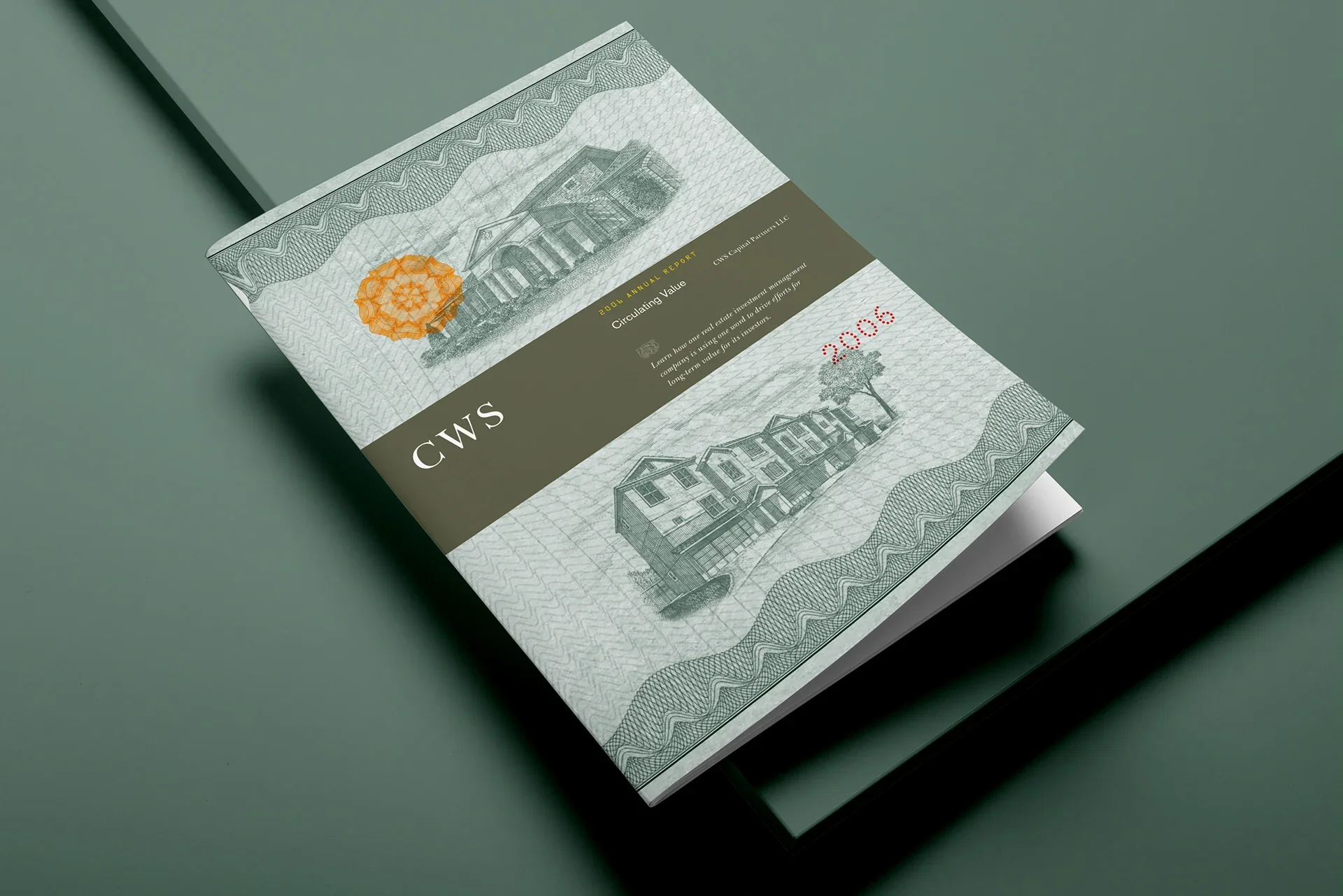
The CWS Capital Partners 2006 annual report, designed by Ramp Creative (that’s us). Front cover with etching illustrations and money band.
Example: Annual Report design with Michael
When Michael and I designed the “Circulation” annual report for CWS Capital Partners, the strategic question wasn’t “how do we present these financials?” It was “why should investors care about this story?”
Our answer: Money, like blood, must circulate to create life and growth.
That became the spine. Every design choice reinforced it. The book felt like currency—guilloches, textured paper, a money band. The CD, with the full set of financials, looked like a penny. Every illustration was rendered as an engraving.
But more importantly, the concept gave investors a lens to understand the entire business strategy. It wasn’t just clever design—it made complex financial strategy emotionally graspable. It mattered because it gave people language to talk about what the company was trying to do. (And yes, Michael hid our birthdays in the currency serial numbers, for fun. Michael loved those kinds of Easter eggs.)
Result: Investors remembered it. New prospects asked about it. It won design awards. But more importantly, it made the financial story stick.
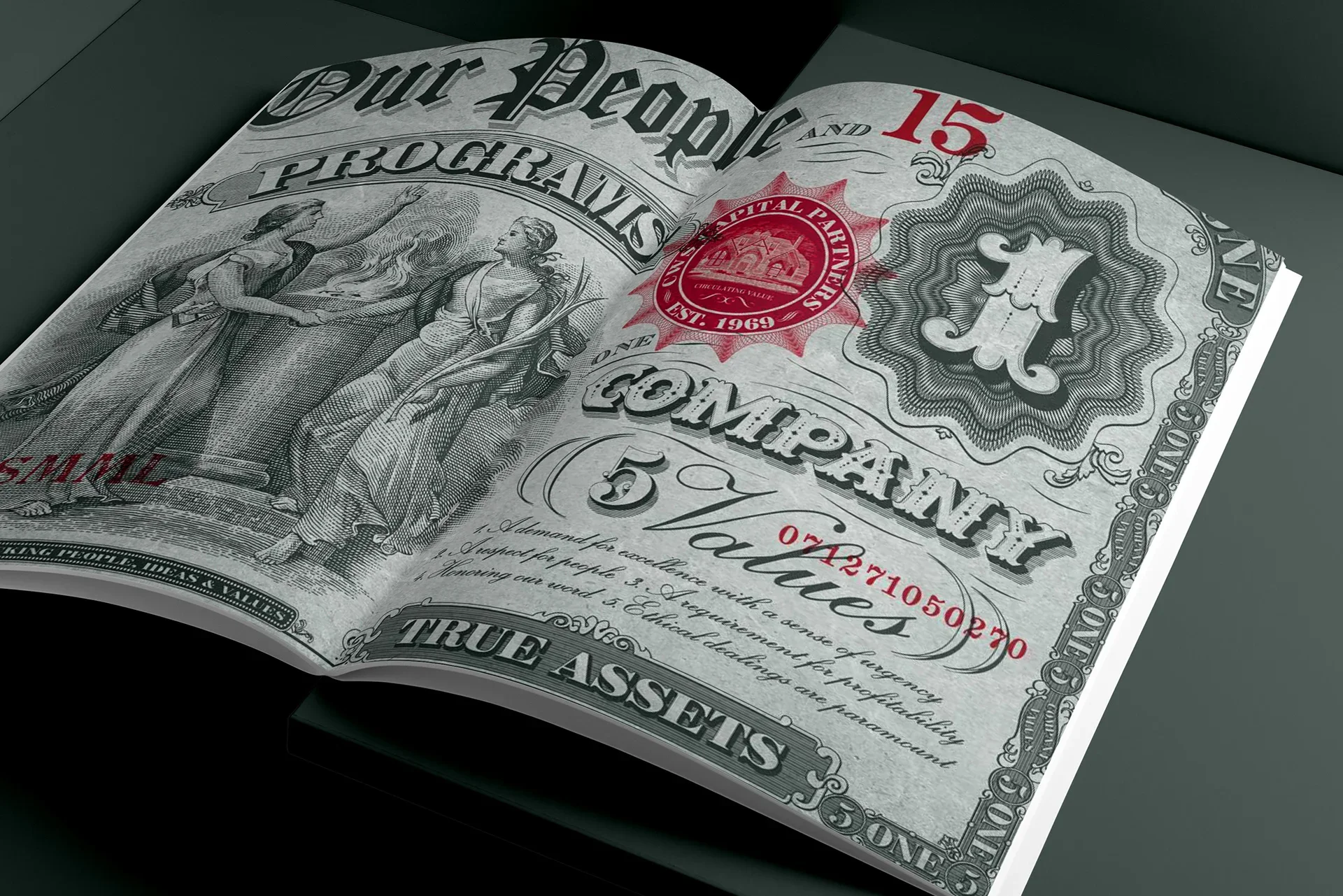
The CWS Capital Partners 2006 annual report, inside spread.
Stick: What Should Remain If They Forget 80%?
Strategic memorability isn’t about retention tactics. It’s about cognitive footprint.
The question Stick answers: What is the one thing this program wants to be remembered for?
This is the most misunderstood part of Clear, Matter, Stick.
How I Pressure-Test for Stick
If someone forgets 80% of the program, what should remain?
What phrase, model, or lens should permanently alter how they see their work?
What would be missing if this program never existed?
If people can’t think differently after engaging with your program—even vaguely—it didn’t stick.
Stick = lasting mental reorganization.
What Makes Things Stick at the Strategic Level
Repeatable structure: Creative Connections had a three-part format people could recognize and count on. Case Study → Demo → Community. That consistency made it easier to remember what the program was about.
Named concepts: The “Circulation” metaphor gave people a shorthand. They could say “it’s about circulation” and everyone who’d seen the report knew exactly what that meant.
Participation: The most memorable event I ever attended was an AIGA leadership retreat in 2008. The facilitator had everyone physically move to different sides of the room based on one’s Myers-Briggs aspects. Introverts one side, extroverts the other, ambiverts in the middle. Suddenly you could see the personality landscape of the community. It was participatory, visual, vulnerable. I still remember it 18 years later. (And I can still tell you where I stood in that room.) That’s the power of designing moments that engage the body, not just the mind.
Actionable frameworks: Creative Jam participants walked away with portfolio work, professional connections, and a process they could repeat. Creative Connections gave them workflows they could immediately apply. The stickiness came from impact, not memory tricks.
How This Approach Works (It’s a Loop, Not a Checklist)
Clear, Matter, Stick isn’t linear. It’s not a checklist where you do step 1, then step 2, then step 3, and you’re done.
It’s a way of thinking that cycles until the program’s intention feels inevitable:
You get clarity → realize it doesn't matter to anyone yet
You add relevance → realize it’s now too complex
You simplify → realize nothing sticks
You name something → clarity improves again
That iterative process is what makes Clear, Matter, Stick an approach, not a formula. You can’t just apply it once and be done. You have to think with it. You have to iterate.
What This Prevents
Using Clear, Matter, Stick at the strategy level protects you from overstuffed programs, clever ideas that don’t work, audience mismatch, “just one more thing” feature creep, and execution chaos.
It creates strategy that execution teams can actually execute, speakers can align to, audiences can own, and momentum that extends beyond the program itself.
Which is exactly why it belongs in —at the beginning, before you plan sessions, book speakers, or design experiences.
How to Apply This Mindset to Your Own Work
I’ve been thinking this way for nearly 30 years—I’m only now codifying it into something I can teach. And this strategic mindset can work for your events, programs, and experiences too.
Here are three ways to apply this thinking:
As a diagnostic: When a program isn’t working, pressure-test its intention against these three questions. Is it clear what people should walk away understanding? Does it actually matter to them (not just to you)? Will anything stick beyond the moment? Usually one of these is missing. Sometimes all three.
As a design approach: Before planning anything—agenda, speakers, format, activities—answer these questions first: What needs to be crystal clear? What must matter to this specific audience (what tension are you resolving for them)? What should stick (what’s the one thing they should remember if they forget everything else)?
As a refinement tool: When you have too much content and no focus, use Clear, Matter, Stick to find the intention. What’s essential to the clarity? What actually matters to your audience versus what you just think is interesting? What will stick versus what’s just nice-to-have?
This mindset works for any event, program, or experience where ideas need to land, not evaporate. And if you need help applying it to your work, reach out—I’m building my practice around helping people design event programs that actually stick.
The Real Test
A week after someone experiences your program, can they explain what it was for? Can they tell someone else why it mattered? Do they remember anything that changed how they think or work?
If yes to all three, you’ve built something with a spine. That’s what separates programs that create change from ones that just take up time and budget.
After nearly 30 years of conferences, I know this: Clear, Matter, Stick isn’t just about better communication. It’s about respecting people’s time, money, and attention enough to be intentional—and designing everything to serve that intention.
Go build something that lands. And if you ever find yourself adding “just one more thing,” ask yourself: does it serve the clarity? Does it matter to them? Will it stick?
(You’ll thank me later. And if you hide an Easter egg, send me a clue—I’m always up for a good hunt.)